Concrete retaining walls in Pittsburg CA - a sloped yard that stays put
Slope sliding onto the patio or an old wall leaning out? We build a poured wall sized to your yard, with a drain behind it.
- Fully licensed and insured.
- Free on-site estimates.
- Expect a reply within 1 business day.
What goes into a concrete retaining wall in Pittsburg?
The short answer: Concrete retaining walls in Pittsburg, CA hold back the soil on a sloped yard and stand up to the sideways push of the earth behind them, so the ground above stays put and you get usable flat space below.
Most calls start with a slope that keeps sliding onto a patio, a backyard too steep to use, or an old wall that's started to lean. Besides the dirt, a wall may have to carry water in the ground, a parked car or a building up top, and the shaking of an earthquake, and all of that goes into how it's built. The price moves with the wall's length and height, how much digging the footing takes, how easy it is to get into your yard, what sits near the top and the finish you pick for the face. The schedule turns on what the city wants before we dig and on curing, the wait while fresh concrete gains strength before any soil goes behind it. My estimate lays that out for your yard and says what's included and what isn't.
How do you know your slope needs a retaining wall?
An old wall leaning out
If the top of an old wall is tipping toward you or the face is bowing out, the soil and water behind it are usually pushing harder than it was built for. A leaning wall doesn't straighten itself, and the longer it goes, the more it costs to take down and haul off before a new one goes in.
Mud washing onto the patio
After a rain you're sweeping mud off the patio or the driveway, and the bottom of the slope keeps creeping closer. That's a bank with nothing holding it, and every wet season it carries more soil down and starts eating at the edge of whatever it lands on.
Soggy ground behind the wall
The ground at the top stays wet for days after rain, or water seeps through cracks and stains the face while the drain holes near the bottom stay dry. That usually means the water behind the wall has no clean way out, and the problem grows with every rainy season.
How we build concrete retaining walls
I start with the slope and whatever sits near the wall, like a driveway or a shed, because those decide how hard the ground pushes and so how the wall gets built. Our crew digs out and packs the ground under the footing, the wide concrete base that keeps the wall from tipping or sliding, then sets the forms and the rebar, steel bars that hold the concrete together when the soil leans on it. We schedule the pour to miss the midday heat, since a wall that dries too fast ends up with a weak, dusty face. Behind the wall we put in a drain you can clean out later, because water trapped back there pushes on the wall. Once the concrete has gained enough strength, we fill behind it in thin packed layers, using equipment that won't shove the new wall, and then we clean up.
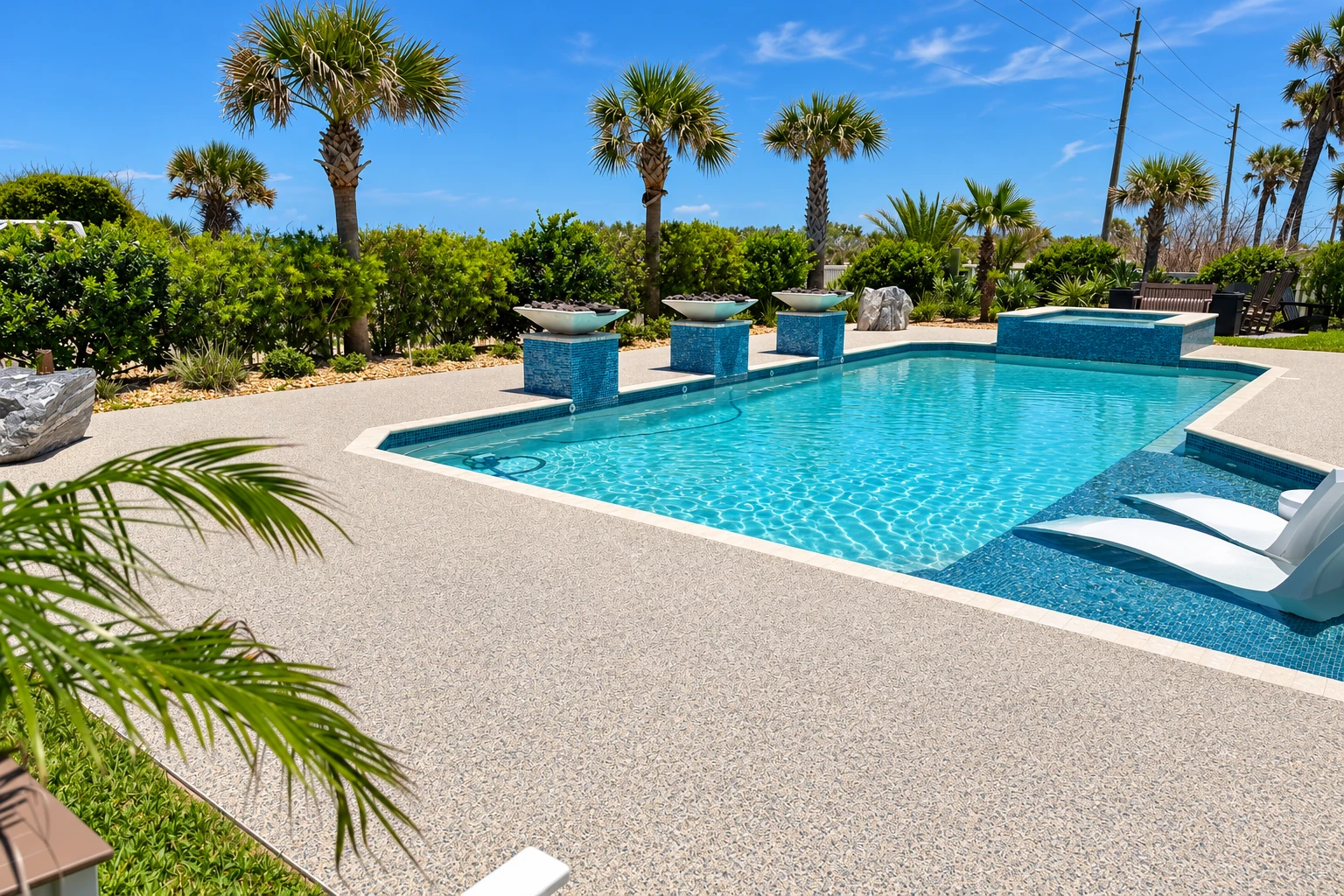
A wall often opens up level ground, and that's where concrete floor installation comes in for a shop or a storage building. On a hillside lot with a pool, the wall usually works alongside concrete pool decks, and we plan the two together so water off the deck doesn't end up behind the wall.
Plain poured face
A smooth or lightly textured gray face suits a wall along a driveway or at the back of a yard, where it's there to do a job. It keeps the money on the footing, the steel and the drain, which is where I'd put it first.
Colored or textured face
Poured concrete can be colored, given a texture or set with stones or tile in the face, and done right it leaves more room for a custom look than other wall materials. It suits a wall you'll see every day from the patio, and the look gets planned along with the structure, not added after.
What happens after you call about a retaining wall in Pittsburg?
Here's how a retaining wall job runs with us, from your first call to the walk-through at the end, and who you'll be dealing with at each step.
- Step 01
Call us or send the form
Reach us at (925) 318-8157 or through the form, and we get back to you to set a time that works. Then I come out to see the slope.
- Step 02
I walk the slope with you
I look at where the water goes and what sits near the top, and I ask a lot of questions before I write anything. You get a written estimate that says what's in the price and what isn't, so you know what you're paying for.
- Step 03
We build, clean up, walk it
If you go ahead, I run the job with our crew and tell you in plain words what's happening at each stage. When it's done, we clean up and walk the finished wall with you.
What changes a concrete retaining wall job in Pittsburg
The state's seismic hazard maps show areas where the ground may liquefy, turning loose and soft, during a strong earthquake. In California, people developing property in a mapped zone may be required to look into that hazard and reduce it as part of the local permit process, which is one more reason a wall's design depends on its site. Whether your wall needs a permit, and what the city wants for it, is the city's call, so we check with the local building office early in planning and walk you through what they tell us. When a permit is needed, we take care of pulling it.
Around Pittsburg, a lot of the walls we're asked about sit at the back of sloped yards or along driveways set above or below the house, where the wall carries more than dirt. We're based in Pittsburg and take jobs in the cities around it, and we see the same kind of hillside lots in Antioch and Concord, so call even if your city isn't listed.
Get a written estimate for your retaining wall
We'll get back to you within one business day to set a time for me to come out and look at the slope. The estimate is free, done on site and comes with no obligation, so there's no pressure to book.
Why Pittsburg homeowners call C&K Pittsburg Concrete Company
One person from estimate to cleanup
The same person who writes your estimate runs the job with our crew, and I've worked that way since I started this business in 2021. Nothing you told me on the first visit gets lost in a handoff.
Licensed in California, fully insured
We're fully licensed and insured. California's contractor license board describes a concrete contractor as one who forms, pours, places, finishes and installs concrete work, which is what a retaining wall comes down to.
Straight answers about the hidden parts
Most of what makes a wall hold ends up buried, so I explain the footing and the drain in plain words and tell you when an answer has to come from an engineer or the city. Your satisfaction, guaranteed.
With a retaining wall, the work that counts most is the part you won't see once the dirt goes back. Contact us and I'll come take a look.
Retaining wall questions from Pittsburg homeowners
How much does a concrete retaining wall cost in Pittsburg, CA?
A poured concrete retaining wall in the Bay Area usually costs about $40 to $55 per square foot of wall face, the flat side you look at. That's the going rate around the region, not our price. Your own number comes from the estimate, after I've seen the slope and what sits near it.
Why does drainage behind a retaining wall matter?
Drainage matters because soaked soil behind a wall pushes harder on it and grips less against sliding. Grainy, gravel-like fill behind the wall drains well, packs down easily and adds to that grip, so the fill matters as much as the concrete. When you compare bids, ask which drain each plan uses, since one built to be cleaned out holds up better than plain weep holes, the small holes through the wall, which tend to clog.
How do I figure out how big a retaining wall needs to be?
Height alone won't tell you, because the footing, the steel inside, the drainage and what's assumed about the soil should come from a design for the job or the building code that applies. That means your wall gets planned around your own yard, not copied from a stock drawing for its height. When a wall needs an engineer's design, I'll tell you on the first visit.
Can I add a driveway near my retaining wall later?
You can, but it should be planned for, because adding a driveway near the wall, changing the fill behind it or letting water build up can undo what the wall was designed for, even when the concrete itself is strong. If something like that is in your future, tell me before we plan, so it gets built in from the start.
What should a retaining wall contract in California include?
The state's contractor license board says a home improvement contract has to include information, notices and disclosures meant to protect you. Any change to it has to be in writing, easy to read and understand, and has to tell you about your right to cancel. We put changes in writing the same way, so you can see what you agreed to.
What causes a concrete retaining wall to fail?
Usually it's more push from behind than the wall was planned for, from trapped water, a new load up top or fill that changes. Some clay-type fill soils swell sideways as they get wetter, and a design that leaves that pressure out can lose stability, sometimes to the point of failure. That's why I ask what's behind and above the wall before I price it.
Related concrete work for sloped yards
Concrete floor installation
A level pad behind a new wall is a good spot for a slab under a shed or a parked car, poured on a well-packed base.
Concrete pool decks
A pool set into a sloped yard needs a deck that's comfortable underfoot, slopes water away and meets the retaining wall cleanly at the edge.
Send us photos of your slope
Call (925) 318-8157 or use the form, and a few photos with a rough length and height, plus any driveway or building nearby, let me show up with the right questions.